
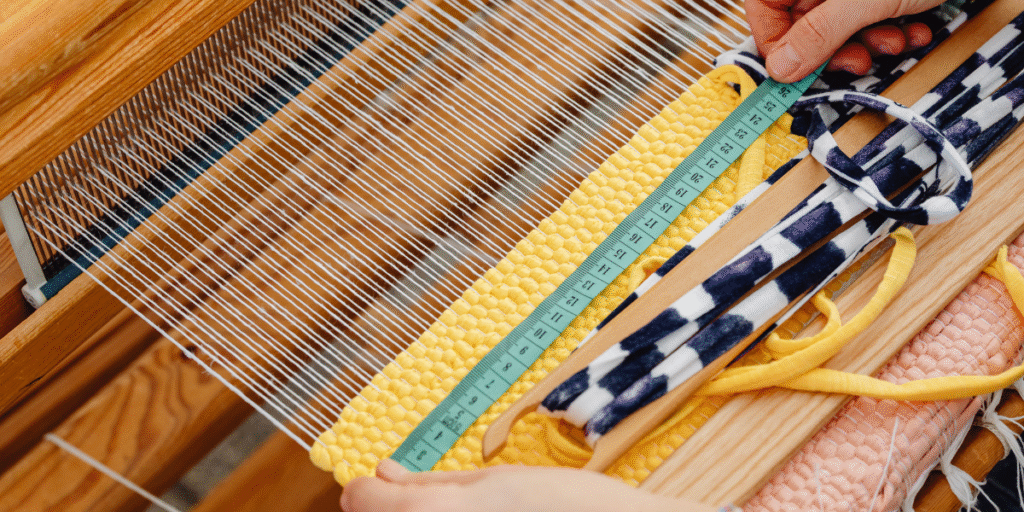
Narrow woven fabrics are textile products manufactured on specialized looms with a width typically less than 12 inches. Unlike broad fabrics, they are woven in continuous narrow widths and cut to length, making them ideal for strength-critical and functional applications rather than decorative use.
They are commonly produced as woven tapes, webbings, elastics, bindings, belts, and straps, designed to offer high tensile strength, durability, flexibility, and load-bearing performance for industrial, safety, and commercial uses.
Key Characteristics of Narrow Woven Fabrics
Narrow woven fabrics are preferred in industrial applications because they offer:
- High strength-to-width ratio
- Controlled stretch and flexibility
- Uniform weave structure
- Resistance to abrasion, moisture, and UV exposure
- Consistent width and thickness
These features make them essential in industrial narrow woven fabrics used for safety, lifting, automotive, and military purposes.
Types of Narrow Woven Fabrics
Understanding the narrow woven fabric types helps in selecting the right material for specific applications.
1 Woven Tapes
Flat, lightweight fabrics used for reinforcement, packaging, edging, and binding. Common in apparel, medical, and industrial sectors.
2 Woven Webbings
Heavy-duty fabrics engineered for load-bearing applications such as safety harnesses, slings, dog leashes, and lifting straps.
3 Elastic Narrow Fabrics
Woven with elastomeric yarns to provide controlled stretch, widely used in medical braces, waistbands, and industrial supports.
4. Tubular Woven Fabrics
Seamless structures offering flexibility and abrasion resistance, commonly used in climbing gear and safety equipment.
5. Binding & Trimming Fabrics
Used to reinforce edges, improve durability, and provide clean finishes in bags, upholstery, and technical textiles.
Materials Used in Narrow Woven Fabrics
The performance of narrow woven fabrics depends heavily on the yarn and fiber used.
Common Materials Include:
- Polypropylene (PP): Lightweight, cost-effective, moisture-resistant
- Polyester: High tensile strength, UV resistance, long lifespan
- Nylon: Excellent elasticity and abrasion resistance
- Cotton: Breathable and soft, used for non-load applications
- High-tenacity yarns: Used in certified industrial and safety products
These materials allow manufacturers to tailor woven tapes and webbings for specific environmental and mechanical requirements.
Industrial Uses of Narrow Woven Fabrics
Narrow woven fabrics play a critical role across multiple industries due to their adaptability and strength.
Major Narrow Fabric Applications:
- Safety & Fall Protection: Full-body harnesses, lanyards, lifelines
- Lifting & Rigging: Webbing slings, cargo straps
- Automotive: Seat belts, tie-downs, insulation bindings
- Pet Products: Dog leashes, collars, harnesses
- Medical & Healthcare: Orthopedic supports, braces, belts
- Military & Defense: Tactical straps, load-bearing webbings
- Packaging & Logistics: Strapping, reinforcement tapes
- Sports & Outdoor Gear: Climbing ropes, backpacks, tents
Their reliability makes industrial narrow woven fabrics essential where safety and durability cannot be compromised.
Why Narrow Woven Fabrics Are Preferred Over Broad Fabrics?
Compared to wide fabrics, narrow woven fabrics offer:
- Greater dimensional stability
- Better load distribution
- Lower material wastage
- Faster production for functional components
- Easier customization for industrial needs
This is why narrow woven fabrics dominate technical textile applications.
FAQs
Are narrow woven fabrics the same as webbings?
No. Webbings are a type of narrow woven fabric, but narrow woven fabrics also include tapes, elastics, bindings, and tubular weaves.
What is the standard width of narrow woven fabrics?
Most narrow woven fabrics range from 5 mm to 300 mm (12 inches), depending on the application.
Which material is best for industrial narrow woven fabrics?
Polyester and polypropylene are most commonly used due to their strength, durability, and resistance to moisture and chemicals.
Where are narrow woven fabrics used the most?
They are widely used in safety equipment, automotive components, lifting gear, pet accessories, and medical textiles.
Conclusion
Narrow woven fabrics are precision-engineered textiles designed for performance, strength, and reliability. With multiple narrow woven fabric types, diverse materials, and extensive narrow fabric applications, they form the backbone of modern industrial and safety products.
Choosing the right narrow woven fabric ensures safety compliance, durability, and cost efficiency across industries.