
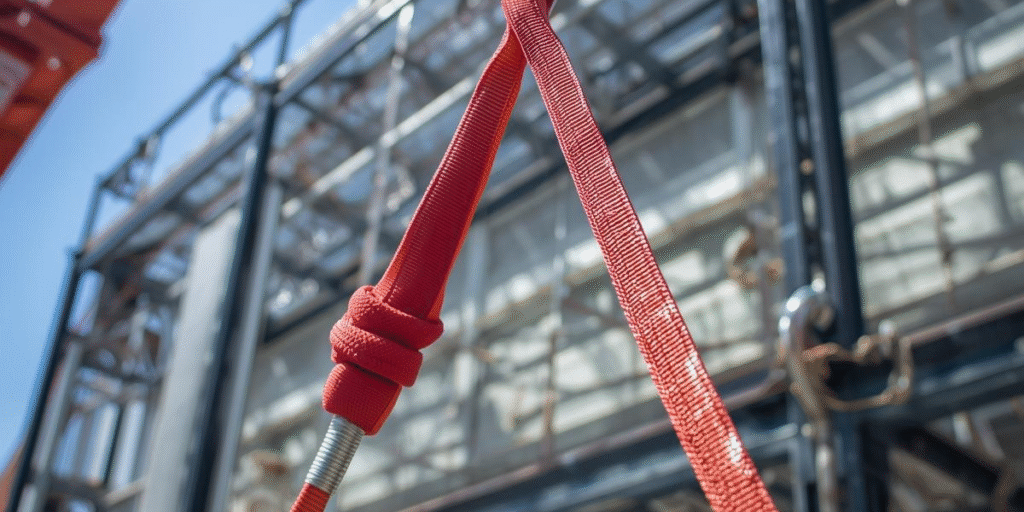
Webbing slings are one of the most essential lifting tools used across construction, logistics, shipping, and heavy-engineering industries. Their flexibility, lightweight structure, and high load-bearing capacity make them a safer and more versatile alternative to traditional wire rope and chain slings.
In this guide, we will cover the three different types of webbing slings, along with material comparison, load capacity insights, industry standards, safety checks, and tips to choose the right sling.
What Are Webbing Slings?
Webbing slings are flat or tubular woven straps made from high-strength synthetic fibres such as polyester, nylon, or polypropylene. They are widely used for lifting, rigging, and material handling due to their durability, flexibility, and ability to lift delicate loads without damage.
The 3 Main Types of Webbing Slings
1 Flat Webbing Slings
Flat webbing slings are made from strong, woven polyester/nylon webbing. They come in single-ply, double-ply, or multi-ply layers depending on lifting requirements.
Key Features
Lightweight, flexible, and easy to handle
Ideal for delicate surfaces—no damage or scratches
Commonly color-coded as per EN 1492-1 standards
Available in a range of lengths & Working Load Limits (WLL)
Best For
General material lifting
Warehousing & logistics
Machinery and fragile loads
Construction site lifting
2. Round Webbing Slings
Round slings are made from continuous polyester fibre yarn encased in a durable tubular sleeve.
Key Features
Extremely flexible, making them ideal for irregularly shaped loads
Higher lifting capacity compared to flat webbing slings
Even load distribution reduces pressure points
Longer lifespan with proper maintenance
Best For
Heavy-duty lifting
Cylindrical loads
Machine installation
Offshore & rigging applications
3. Endless (Infinite Loop) Webbing Slings
Endless slings form a continuous loop, allowing multiple hitching configurations such as vertical, choker, and basket hitches.
Key Features
Highly versatile due to 360° rotation
Cost-effective and long-lasting
Suitable for repetitive lifting operations
Easy to position around loads
Best For
- Repetitive lifting cycles
- Construction & fabrication
- Lifting loads without fixed attachment points
Material Comparison: Polyester vs Nylon vs Polypropylene
Choosing the right sling material ensures safety, durability, and compliance.
| Material | Strength | Stretch/Elongation | Best For | Pros | Cons |
|---|---|---|---|---|---|
| Polyester (PES) | High | Low (3% approx.) | General lifting | UV & moisture resistant | Not ideal for strong alkaline environments |
| Nylon (PA) | Medium-High | Higher stretch (10%) | Dynamic loads | Shock absorption | Affected by acids, UV |
| Polypropylene (PP) | Medium | Low | Chemical/acidic environments | Lightweight & chemical-resistant | Lower temperature tolerance |
Colour Coding & Load Capacity Guide (EN 1492-1 Standard)
| Sling Colour | Working Load Limit (WLL) | Common Use |
|---|---|---|
| Purple | 1 Ton | Light lifting |
| Green | 2 Ton | Industrial lifting |
| Yellow | 3 Ton | Construction |
| Grey | 4 Ton | Medium lifting |
| Red | 5 Ton | Heavy loads |
| Brown | 6 Ton | Heavy lifting |
| Blue | 8 Ton | Heavy machinery |
| Orange | 10 Ton+ | Extreme loads |
(Note: Always follow manufacturer-specific capacity charts.)
Webbing Slings vs Wire Rope Slings
Webbing slings provide unique advantages over wire ropes.
Webbing Slings
Lightweight & flexible
Safe for delicate loads
Easy storage and handling
Rust-free & corrosion-resistant
Wire Rope Slings
- Higher temperature resistance
- Suitable for very abrasive environments
- More rigid and durable for extreme conditions
Bottom Line: For general industrial use, webbing slings are the safer, faster, and more versatile option.
Safety & Inspection Checklist
To maintain performance and avoid accidents, always inspect slings before use.
Before Use
Check for cuts, tears, abrasions
Inspect stitching and label readability
Look for chemical burns or heat damage
Ensure hardware (hooks/shackles) is compatible
During Use
Avoid sharp edges without corner protectors
Do not exceed the Working Load Limit
Maintain correct lifting angle (0°–60° recommended)
After Use
Store in a cool, dry place
Keep away from chemicals and direct sunlight
How to Choose the Right Webbing Sling?
Use this quick guide before selecting any sling:
- Load weight & shape
- Material requirement (PES / PA / PP)
- Lifting method (vertical, choker, basket)
- Temperature & chemical exposure
- Industry standard compliance (EN 1492-1 / ASME B30.9)
- Length & ply requirements
For industrial buyers, choosing certified slings ensures safety and long-term performance.
Why Choose JP Fibres Webbing Slings?
JP Fibres is one of India’s leading manufacturers and exporters of high-performance webbing slings, narrow woven fabrics, and polypropylene multifilament yarn.
Our Advantages
- ✔ ISO 9001:2015 Certified
- ✔ REACH & OEKO-TEX Certified Webbing
- ✔ High-strength, long-lasting yarn
- ✔ Custom sizes, ply options & lifting capacities
- ✔ On-time delivery & competitive pricing
- ✔ Tested & certified quality
Whether you need flat, round, or endless webbing slings — JP Fibres ensures durable, safe, and reliable solutions for all your lifting operations.
Conclusion
Webbing slings are an essential part of modern lifting and rigging systems. Understanding their types, materials, applications, and safety guidelines for webbing sling helps you choose the right sling for each job.
By opting for certified, high-quality slings from a trusted manufacturer like JP Fibres, you ensure maximum strength, durability, and safety in every lift.